Monday, June 17, 2013

odds and ends

Not much going on in the way of commissions, awaiting some briefs, waiting for my inbox to flag a new message from someone wanting images, so in the meantime, I have been teaching myself how to skin and rig 3-D models ready for animation.

This character is called Abura-Sumeshi and is an Obakemono, a kind of garden spirit from Japan.. he is a potato/yam-headed chap dressed in rough sack cloth with a straw hat and wooden shoes, he carries a stick with a gourd attached for carrying lamp oil that he steals from people's houses at night. 

This is a long-term project, eventually I will texture him and put him in an environment to make a little animation sequence.

Other than that, I have made a few more Dino images:

Cryolophosaurus

Tyrannosaurus attacking a Triceratops

That's all for now...


Saturday, July 21, 2012

Supermarine Walrus MkII

I managed to finally finish off the 1/72nd scale Supermarine Walrus last week, it has been sitting half finished for months , but just couldn't seem to find the time to complete it.


Pretty much out of the box this one, but added in port and starboard windows, rigging, radio aerials and decided to give it a seawater-weathered finish.


The model features the Supermarine Walrus MkII of 1700 NAS, Operating from HMS Emperor, as part of the British Pacific Fleet in the Far East in 1945.


Although fragile in appearance, this amphibious aircraft proved to be extremely rugged, could take punishment from enemy fire, land on rough seas, and even take the strain of a catapult take-off from a ship. During trials, one Walrus was accidentally landed in the sea with the wheels down, resulting in a sudden and abrupt cartwheel upon contact with the water surface. One would have thought that the aircraft would have been ripped apart and would have sunk with loss of life with such an event, but amazingly the aircraft remained intact, afloat and the pilot was rescued (albeit a bit battered).The aircraft was serviced and back in full operation within a few days!

The walrus was used effectively throughout WW2 predominantly as a reconnaissance and rescue aircraft (assigned to rescuing downed pilots adrift at sea). This particular model features the aircraft flown by Lieutenant A.F.Lawrence RNVR, who rescued a pilot from the sea, 200 yards from Japanese forces on Car Nicobar on July 8th 1945.


Friday, March 16, 2012

Tough Times

It's been months since my last update, a combination of lack of funds, shortage of commissions and day-to-day distractions and difficulties resulted in little or no activity worth posting about.

Through the worst of it now, but still, can't say the past 6 months have been the best in my life.

Got to take the rough with the smooth I guess, so ....onwards!

I have done no scale modelling whatsoever since October and have a poorly abandoned Supermarine Walrus sitting waiting to be finished off...I have managed to produce a few illustrations though and have also been updating art assets for Aventurine SA and the much-fabled and long-awaited "Darkfall 2.0".

So, here are some shots of some boats (have done lots of other things, but this will do for now I guess) and a couple of Spinosaurus fishing on a beach


Monday, October 24, 2011

Blohm and Voss BV141 V10 (B-02)


Finally put the finishing touches to the 1/72nd scale ww2 tactical reconnaissance aircraft, the Blohm and Voss BV141.

This is one of the most asymmetrical and unorthodox aitrcraft to appear in WW2. Although it never went into operational service, this was not due to any failings with the design. There were plans to form a squadron in Russia, but this never was actioned and all development was scrapped by 1942.

I added the white band marking to the rear boom, indicating allocation to a western front squadron, and whilst this is a flight of fantasy, I have seen reference shots of an actual aircraft (albeit not the NCRA aircraft featured) with similar markings , and thought it added to the overall effect.

Not in itself a very complicated model to build, but there were a few issues that would catch out any modeller without some due dilligence:

i) The cockpit was devoid of any details, owing to the amount of clear plastic, it is neccessary to delve into a bit of modification and scratch-building for the interior.


ii) the cockpit halves do not marry up that well and the clear plastic does not seat well (lots of gaps), and there is quite a bit of that!


iii) the clear plastic is a real trial to paint, lots of it, very fiddly and requires a steady hand. I have seen examples of other models where cocktail sticks, painted transfers and masking have been used to moderate effect. I thought I would just get on with it and paint it freehand.. the results are passable.


iv) the bombloads on the underwing have to be added after the registration decals (not mentioned in the instructions), plus the Balkankreuz on the underside have to lie over very prominant control surfaces, requiring cutting and re-touching...and do not match up with the wheel bays... not for the faint hearted or novice!

Apologies for my camerawork.. I will take shots of all the models again with a proper set-up when the weather is next good enough for an outside shoot.. might even make a diorama for them to sit on.

Friday, October 14, 2011

October already

Not been updating the blog recently, I have been a bit slack for a multitude of reasons.
Not a lot of modelling activity recently either, but I am working on a fiddly 1/72 scale model of a WW2 BV141 tactical reconnaissance aircraft, have had a few issues with it and progress is slow, but will upload pictures when completed.

Did a few small pieces of work featuring ammonites and Trilobites, plus a meteorite for use as sample packaging and point of sale.

Thursday, August 11, 2011

Joint Force Harrier


Latest 1/72 nd scale model completed is a BAE Harrier GR7A No.800 NAS Joint Forces based at RAF Cottesmore, Leicestershire.

The build was quite tricky, lots of errors with the instructions and numbering... fun though ;-)

Had to modify the cockpit and ejector seat to get it to fit the fuselage.

Further to this the Kit contained components for other Harrier versions to help confuse things.

Applying decals was an interesting task, lots of them and mostly microscopic!


Tuesday, June 14, 2011

Westland Lynx HAS.3


OK, next off the bench is a Westland Lynx HAS.3 of the 815 Naval Air Squadron, Fleet Air Arm operating from HMS Exeter, April 1987. The white canisters are housings for ships' biscuits and rum...

edit: ok, rum was stopped back in the 70's (thanks f.y.i. Ian)

I am guessing that the white ordinance are anti-submarine torpedo, but despite some research I am still ignorant.

Thursday, June 2, 2011

Dinosaur colours

It has often been speculated as to the colours of Dinosaurs, as it was previously thought that the fossilisation process does not lead to the preservation of colouration.. that is until recent finds unearthed in China had been studied more closely.

Sinosauropteryx is one of the first genus of Dinosaur (non-avian) to be found with fur-like feathers where evidence of colouration was still partly preserved.

So, without further nerdiness here is a recent illustration of this Therapod from Liaoning Province.

Saturday, May 7, 2011

Vought Corsair Mk.IV/FG-1D


KD658/115, as flown by Robert Hampton "Hammy" Gray VC DSC. no.1841 Naval Air Squadron of the Fleet Air Arm, flying off HMS Formidible as part of the British Pacific Fleet 1945.

Gray joined the Royal Canadian Naval Volunteer Reserve in 1940 and went on to fly Hurricanes out of Tanga and Mombasa and later joined 1841 NAS on HMS Formidible.

Having seen action against the German battleship
Turpitz, Grey was mentioned in dispatches for his skill and courage in 1944.

A year later he was still with HMS Formidible, but this time in Tokyo Bay, July 1945.
One month later, Gray was to be killed in action whilst attacking and sinking a Japanese destroyer, his heavily damaged aircraft last seen crashing into the sea. Gray was posthumously awarded the VC for his gallantry and bravery, which was also recognised by the Japanese, who dedicated a memorial to him at Onagawa Wan, Honshu (the only such dedication to a foreign combatant to be found on Japanese soil).

Sunday, May 1, 2011

Stringbag

Finished off a 1/72nd scale model of a Fairey Swordfish Mk.1 the other day. It is No.825 Naval Air Squadron, based out of Manston, England in February 1942. As flown by Lt-Commander Eugene Esmonde V.C., D.S.O. Esmonde and his crew (Petty Officer Clinton and Observer Lieutenant Williams) were to be killed in action in this aircraft whilst attempting to sink German Naval vessels.

To launch their torpedos, the pilots had to fly low and level and slow, whilst being shot at by anti-aircraft guns, machine guns and cannon from not only the enemy ships, but also their accompanying aircraft cover provided by Luftwaffe Me 109's and FW 190's.
Needless to say, despite the Swordfish's ability to take severe punishment, losses in combat were high. Esmonde and his crew were to receive posthumous awards for gallantry, Esmonde receiving a Victoria Cross.

Friday, April 15, 2011

Futabasaurus


Futabasaurus was a 7 metre-long Plesiosaur that lived in the Late Cretaceous period, the remains of which have been found in and around Fukushima in Japan. Yes that's the same place that was hit by the earthquake and Tsunami last month and has that Nuclear nightmare on it's hands right now...

Oddly enough, this was the last commission from my Japanese client, just before the earthquake struck.

It's all gone quiet since :-(

Tuesday, April 12, 2011

A bit quiet

It's been a bit quiet recently, I have not been working on any illustrations for a few weeks now, but have started making my 1/72nd scale WW2 Naval Fairey Swordfish biplane model to keep me busy in my spare time.I will post up pics of this when I have finished it. Apart from that, to keep things ticking over, here is an illustration of a Pterygotus I made earlier in the year. It is a giant sea scorpion over 2 metres in length that lived in the Devonian Period, about 360 million years ago. The model is a re-working of an old one from my archives, completely re-uv'd, textured, with new maps and shaders.

Thursday, March 31, 2011

A different kind of modelling

Making models and art in digital format is all very well, but sometimes I really miss the tactile aspects of making things and building actual models in real space. During my childhood I spent many hours making model aircraft, mostly 1/72nd scale Airfix kits, and thought that it would be nice to take a trip down memory lane and have a go it again, so, some 32 years later here is my first attempt at modelling.

1/72nd scale Sopwith Pup N6453 as flown by SCO E.H.Dunning DSC (Royal Navy), which was the first aircraft to land on a ship, HMS Furious, on August 2nd 1917. Sadly, Dunning was killed five days later whilst attempting a second landing.

This model is part of a box set commemorating 100 years of Naval Aviation History, being a novice I made my first error in choosing to make my first model of the collection of 5 this very small and fiddly biplane, talk about in at the deep end!

Pic i) Out of the box, I can see that the model needs some modifications to make it more accurate to the actual aircraft.

1: drilled in holes to accept rigging (not supplied in the kit)
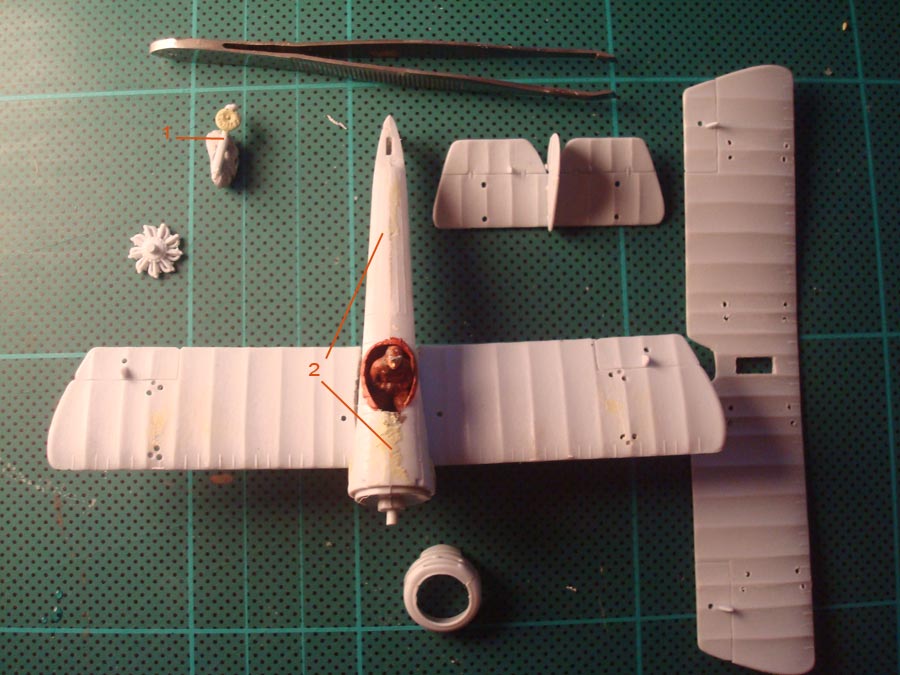
2: This particular pup had an upwards-facing tripod mounted Lewis gun, the model kit came with a front-facing Vickers gun.This yellow blob is the start of me modifying the supplied gun using Milliput.

3: Also using Milliput to make oval inspection panels (kit shows square format)

4:Cut away rear section of fuselage infront of rudder post.

5:Cut away section in top wing to allow for Lewis gun mounting. This configuration was used for shooting at zeppelins.


Pic ii) Assemby and filling.

1:Vickers gun modified into a Lewis gun (of sorts)

2: filling bad seams and a sunken section on the model

Pic iii) Model with base paint, lower wings, gun and cowling added.

1: carved out step, model only had an outline.

2: engine exhaust added (also missing in model), oval panel cleaned up, sanded and painted.

3: Lewis gun and scratch built tripod mount added.

Pic iv) Top wings and tailplane sections added and taped whilst drying.

1: note holes drilled for rigging, this proved almost impossible to fill and sand flat afterwards, next time I will try a different approach.

2: horrible misalignment of cabane strut.. will deal with it later!


Next stages included rigging, painting, varnishing and adding decal markings, propeller and undercarriage, but my camerawork let me down and I managed to shoot only blurry photos of that.. doh!


So we have a small (but probably thankful for all our sakes) jump to the finished thing.

In retrospect I would do things a bit differently, the rigging is not to the correct scale, I have to do some testing with different techniques and materials to get better results. I would not drill all the way through the upper wing, as it was difficult to remove the resulting glue and filler lumps without destroying surface details. I would also try to use thinner coats of paint and a different varnish (the matt one I used dried with milky patches for some unknown reason).


Overall though I am 80% happy with the end result, considering that it is such a small, delicate and fiddly model to start off the project with (only 11.5 cms wingspan). Build time 4 evenings,16 hours total. Next in line on the bench is a Fairey Swordfish.


Friday, March 25, 2011

Brachiosaurus


I guess it's time to add a Dinosaur, although odd looking and substantially different from anything that roams the earth today, they have become an everyday item to me over the past years. Here we have a lone Brachiosaurus walking along the shore of a lake at sunset, somewhere in what is now East Africa 150 million years ago. It disturbs a Rhamphorhynchus which flits about until it can return to it's fishing.

Tuesday, March 22, 2011

Steller's Sea Cow


This poor thing also went the same way as the Dodo. Hydrodamalis gigas was hunted to extinction within just 27 years of it's discovery by westerners.

Slow moving and unable to submerge, it was easy prey for the hunters.It's fat was used as a substitute for butter and also as a smokeless and odourless oil for lamps.

Monday, March 21, 2011

Desmostylus


A Hippopotamus-like herbivorous mammal warms itself in the morning sun, whilst it's mate forages for plants in a pool of brackish water 20 million years ago.

Friday, March 18, 2011

Prize Spinosaurus

Recently brought in to the "Antiques Roadshow" for valuation, this 19th Century painting (circa 1830) features a prize fighting Spinosaurus, property of the estate of Gooday and Hughes.

The letter of provenance informs us that this portrait was made after the animal's final successful championship bout (which netted the owner 129 Guineas 12 shillings and sixpence, plus five years supply of the new fangled Patum Peperium , or Gentlemen's Relish, http://en.wikipedia.org/wiki/Gentleman%27s_Relish ). "Brutus" was then put out to stud, providing his services for another 10 years. His free-range roaming presence also had the added bonus of effectively lessening the numbers of bothersome poachers and unwelcome hawkers visiting Parpington Manor, although the number of Red Deer was drastically reduced throughout the estate's grounds during this period.

Interested parties should contact Mr Jon Hughes for any enquiries for purchase of item.

Jurassic Wars DiceMaestro interview

A link to an interview I gave with game manufacturer Dice Maestro after being commissioned to illustrate Dinosaurs for game cards, packaging and promotional material for the award winning game "Jurassic Wars":

http://www.dicemaestro.com/dinosaur-game/jurassic-wars-interview.asp

Thursday, March 17, 2011

Giant Armadillo

Many artworks take quite a bit of adjustment before clients are happy with the end results, this can be for numerous reasons, including (but not limited to) layout restrictions and requirements, content and composition, as well as scientific accuracy. Often artwork has to be approved by not only the commissioning designer, but also editors and scientists. This often results in a bit of email ping-pong and numerous versions of any given image. After about 4 attempts to get this Glyptodon right, I sent this image through for comment:


It had the desired effect...

approved...job done! :
-)

The final artwork looked like this:


fancy a swim?

Perhaps swimming was not such a good idea in the sea 370 million years ago, especially with fish like Dunkleosteus lurking beneath the waves. Ten metres long and weighing three and a half tonnes, this armoured fish was an apex predator...